
What Tuesday’s Primaries Revealed About the Left
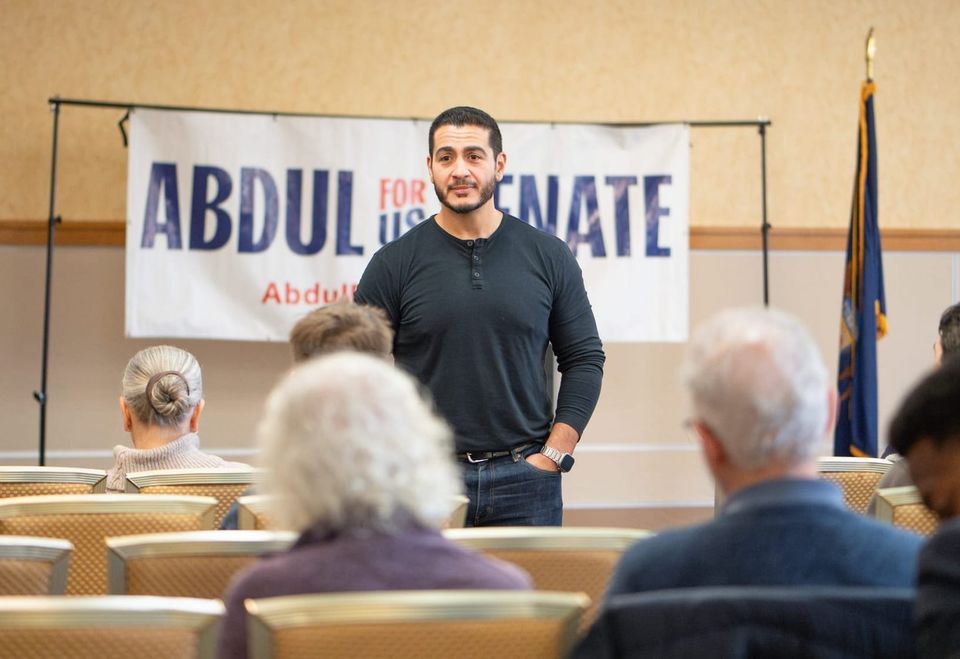
Abdul El-Sayed won. Kansas protected its state Supreme Court. Cori Bush got blown out. Here are five takeaways from Tuesday’s primaries and what they may mean for the left and Massachusetts.
1. Progressives dominated in Michigan
It ended up being a tight Senate primary, with El-Sayed defeating Representative Haley Stevens by only one or two percentage points. But don’t let that fool you: Michigan was an absolute romp for the left.
Including outside spending, some estimates put Stevens’s financial advantage at more than ten to one. Stevens is a congresswoman, endorsed by the popular governor, and recruited by the DSCC. Those financial and institutional advantages ordinarily make a candidate the heavy favorite. Overcoming them was a massive show of strength for the left.
And it didn’t stop there. Donavan McKinney, a DSA member, ousted incumbent Shri Thanedar. Will Lawrence, a co-founder of the Sunrise Movement, beat two moderates in another high-profile race. The left prevailed in several state-level races, too, including Joanna Whaley’s. She is likely to become the first trans woman ever elected to the Michigan legislature.
Michigan is still widely considered a swing state, but its Democratic primary electorate delivered an unmistakably strong night for the left.
2. Progressives benefit from consolidated fields
El-Sayed and McKinney won head-to-head races. Lawrence was the only progressive against a split field of moderates. This follows last month’s New York results, when Brad Lander won his head-to-head matchup against Dan Goldman. Other successful challengers on the left, including Melat Kiros and Claire Valdez, technically faced third candidates, but voters understood both contests as de facto two-person races by Election Day.
The left’s most prominent victories this cycle have come in head-to-head or functionally two-person races.
By contrast, in crowded fields including Illinois-09 and Maryland-05, moderate candidates won pluralities while progressive voters divided among multiple options.
3. Progressives match a key 2010 Tea Party benchmark
The Tea Party’s influence was not measured only by the size of its protests or the number of candidates it elected. A handful of successful primary challenges shifted incentives throughout the Republican Party.
Tea Party challengers ousted four Republican incumbents in 2010. As of Tuesday, progressive challengers have matched that total: Dan Goldman, Adriano Espaillat, Diana DeGette, and Shri Thanedar have all lost primaries from the left.
For those of us who want a stronger Democratic Party, this is great news. It only takes a few successful primary challenges to change the incentives for everyone who remains. Every time an incumbent passes one of these winners in the halls of Congress, they’ll be reminded that ignoring their voters can cost them their job.
4. Ballot measure success
Kansas Republicans failed in their efforts to make the Kansas Supreme Court more partisan. Missouri Republicans failed to institute a regressive tax code, and failed to make future ballot initiatives harder to pass.
All three initiatives are a little wonky, and it’s easy to imagine them causing voters’ eyes to glaze over. Instead, all three were rejected decisively despite support from the dominant party in each state.
The results continue a broader pattern from the past year. The left has not won every ballot initiative, and not every measure divides cleanly along partisan lines. But ballot measures suggest that progressive policies can command support beyond the voters who regularly elect progressive candidates – including in red states.
5. Mixed results outside of Michigan
Progressive success was not limited to Michigan, but Tuesday was not a nationwide sweep.
The clearest non-Michigan example was the Kansas gubernatorial race, where the more progressive candidate defeated an opponent whose campaign focused explicitly on moderate electability.
But Cori Bush lost badly in Missouri, a centrist incumbent survived in Washington, and establishment-backed candidates dominated in Virginia.
Tuesday demonstrated that the left’s momentum extends beyond Michigan and traditional blue hubs. It also showed that the momentum remains uneven: strong enough to produce major wins across the country, but not strong enough to make incumbency, candidate quality, or local political conditions irrelevant.
What does it mean for the left?
Victories in Michigan and Kansas broadened the progressive map, making it harder for skeptics to argue that the left can win only in unusually liberal places like New York City and Denver. But the margins also show that the left’s coalition remains vulnerable to divided fields, uneven candidate performance, and small shifts in turnout. It is strong enough to win nationally significant races, but not strong enough to take anything for granted.
What does it mean to not "take anything for granted" - how can we put that into practice? Help a campaign! The next progressive in a competitive primary is Peggy Flanagan, running for the open U.S. Senate seat in Minnesota. That primary is Tuesday, August 11.
What does it mean for Massachusetts?
Massachusetts’ primaries are less than four weeks away, with few major contests elsewhere before then.
Tuesday’s results are encouraging for congressional challengers Patrick Roath (MA-08, vs. Representative Stephen Lynch) and Jeromie Whalen (MA-01, vs. Representative Richie Neal). Roath and Whalen are young progressives enjoying broad grassroots support and taking on establishment moderates in head-to-head races. At the state level, the same model may benefit Persis Yu and Daniel Lander in their two-person State Senate races, as well as State House challengers such as Andrew Fitch in North Adams.
The results are more cautionary for crowded Massachusetts races, especially the contest to replace Representative Seth Moulton in MA-06. El-Sayed and McKinney won narrowly, while Lawrence prevailed with only 44 percent because the more moderate vote was divided. Combined, these results suggest that the progressive voting bloc is substantial, but not dominant enough to survive self-inflicted wounds. A single consolidated candidate can defeat a larger faction that divides its own vote.
That dynamic could matter in Massachusetts’ two open State Senate races, where crowded fields may weaken the progressive favorites and benefit less progressive alternatives. The risk is even greater in MA-06, where six candidates qualified for the ballot. Five are competing for substantially the same progressive electorate, while the lone moderate is also among the best-funded candidates in the race. If all five insist on staying in, they risk dividing the progressive vote enough to hand a winnable seat to the moderate.
As for the Senate race, Tuesday’s takeaways are muddled. A theme of 2026 Democratic primaries has been younger progressives challenging older, moderate, establishment Democrats. But in the Massachusetts Senate race, the adjectives get jumbled. The younger candidate is the moderate. The progressive has closer ties to the establishment. Tuesday therefore offers little predictive value for the Senate race: major patterns from elsewhere in the country point in contradictory directions here.
 Alex Rikleen
Follow Alex Rikleen on Bluesky at @rikleen.bsky.social.
If this piece helped clarify what’s happening and why it matters, I hope you’ll consider becoming a paid subscriber. The articles will remain free and public, but paid subscriptions help keep this work sustainable.
Member discussion